
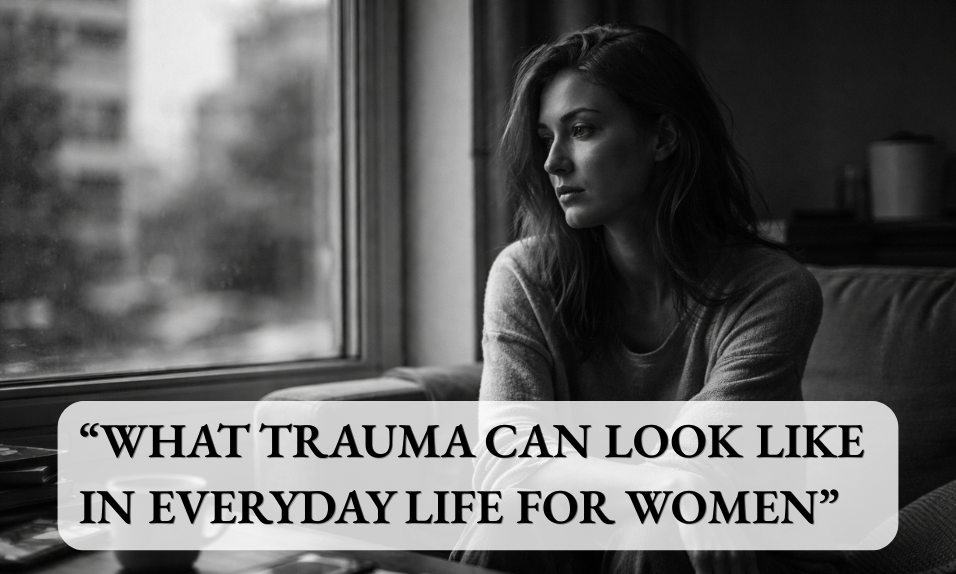
Trauma is often spoken about as though it belongs only to the past, attached to events that were extreme, visible, or easy to identify. But for many women, trauma is not confined to a single memory or a clearly defined chapter. It continues in the present through habits, emotional responses, beliefs, and body-based patterns that shape everyday life.
It may not always be obvious to other people. In fact, some of the women carrying the deepest strain are often the ones who appear the most capable. They go to work, care for children, manage homes, meet expectations, support others, and keep moving. They are called dependable, strong, organised, and resilient. Yet beneath that appearance, there may be a constant state of internal pressure, as though the body never fully receives the message that it is safe to rest.
This is one of the reasons trauma can be so difficult to recognise. It does not always look like a collapse. Sometimes it looks like high-functioning distress. Sometimes it looks like overachievement, silence, emotional distance, perfectionism, people-pleasing, chronic tension, or the inability to stop anticipating what might go wrong.
For many women, trauma lives in ordinary moments.
It can appear in the need to think through every possible outcome before making a decision. It can show up in the instinct to scan other people’s moods, expressions, and tone of voice for signs of danger or disapproval. It can be present in the inability to sit down without guilt, in the urge to stay useful at all times, or in the discomfort that arises when life becomes calm.
A woman may tell herself she is simply anxious, overly sensitive, too emotional, too guarded, too controlling, or too independent. But often these are not random personality flaws. They are protective responses. There are ways the nervous system has learned to prepare, prevent, reduce risk, or remain emotionally guarded to survive what once felt overwhelming.
Trauma Can Live in the Body
Trauma is not only something a woman remembers. It is often something her body continues to carry.
The body may remain tense long after the original threat has passed. Muscles tighten without conscious awareness. Sleep may be light or interrupted. The mind may stay alert, even during moments that should feel peaceful. Rest can feel difficult, not because rest is unwanted, but because slowing down may trigger unease.
Some women live with a persistent sense of internal readiness, as though something may go wrong at any moment. This can create chronic fatigue, digestive issues, irritability, difficulty concentrating, headaches, panic, or a feeling of never being fully settled. The body keeps responding to danger that is no longer present, because trauma can train the nervous system to expect harm even when the environment has changed.
This can be confusing, especially when a woman’s life on the outside appears stable. She may wonder why she cannot calm down, why she overreacts, why she feels exhausted after ordinary interactions, or why peace feels unfamiliar rather than comforting. These experiences are often signs of a body doing what it learned to do well: remain prepared.
Trauma Can Shape Emotional Life
Not every woman responds to trauma in the same way. Some become highly emotional and reactive. Others become emotionally numb. Both can be responses to pain.
When too much has been carried for too long, emotions may feel difficult to regulate. Small disappointments can feel much bigger than they appear from the outside. Conflict may bring intense fear, shame, anger, or shutdown. A woman may cry easily, feel flooded by stress, or struggle to recover after something upsetting happens.
On the other hand, trauma can also create distance from emotion. A woman may struggle to identify what she feels, speak about it, or even access it. She may feel disconnected during experiences that once would have moved her. She may appear calm when she is actually shut down. This can happen because emotional detachment can become a form of protection when feeling fully was once too much to manage.
Many women move between these two states. At times they feel everything intensely. At other times they feel very little at all. This inconsistency can be frustrating, especially when they judge themselves for not responding in a more balanced way. But trauma often disrupts emotional regulation, making it harder to stay grounded during stress and harder to remain connected during calm.
Trauma Can Affect Relationships
Trauma frequently changes the way a woman relates to other people.
She may become highly aware of the needs, moods, and expectations of those around her. She may learn to keep the peace, avoid tension, and make herself easy to be around. She may become the one who apologises first, explains herself too much, or ignores her own discomfort to prevent conflict.
People-pleasing is often misunderstood as simple niceness. In many cases, it is a strategy rooted in survival. If connection once depended on being agreeable, quiet, useful, or emotionally undemanding, those behaviours can continue long after the original circumstances have changed. A woman may know intellectually that she is allowed to have needs and limits, yet still feel guilt, fear, or panic when she tries to express them.
Trauma can also create difficulty with trust. Some women expect rejection even in healthy relationships. Some brace for disappointment. Some struggle to believe kindness is genuine or lasting. Others become emotionally distant and self-protective, keeping people at a careful distance so they cannot be hurt. They may want closeness deeply while also feeling threatened by it.
This can make relationships feel complicated. A woman may long for care but find it difficult to receive. She may want stability yet feel suspicious of it. She may misread calm as disinterest or predictability as a warning sign that something will soon change. Trauma can interfere with the ability to feel secure, even when support is present.
Trauma Can Influence Boundaries
Many women who carry trauma have a complicated relationship with boundaries.
Some were never taught that boundaries were allowed. Some were taught that saying no would lead to punishment, guilt, rejection, or withdrawal of love. Some learned that staying agreeable was the safest option available. Over time, this can make it difficult to recognise discomfort as important information.
A woman may say yes when she means no. She may tolerate behaviour that unsettles her. She may struggle to identify where her responsibility ends and another person’s begins. She may feel guilty for protecting her time, space, energy, or body. She may only notice that a line was crossed after the interaction is over.
This does not happen because she lacks strength or clarity. It often happens because trauma taught her to prioritise survival over self-trust. When the nervous system has been shaped by fear, keeping other people comfortable can feel more urgent than staying connected to personal limits.
Learning boundaries in adulthood can therefore be more than a communication skill. It can be part of healing. It can involve recognising that safety does not require constant self-betrayal.
Trauma Can Appear as Overachievement
One of the most overlooked ways trauma shows up is through achievement.
Some women become exceptionally competent. They perform well, stay busy, remain productive, and appear to handle everything. They are praised for their discipline, reliability, and strength. Yet underneath that performance, there may be fear driving the entire system.
If a woman learned early that she was valued for what she could do rather than for who she was, she may attach safety to usefulness. Rest may feel undeserved. Mistakes may feel intolerable. Falling short may trigger shame far beyond the actual situation. She may drive herself relentlessly, not because she is simply ambitious, but because slowing down would leave her alone with emotions she has spent years outrunning.
Perfectionism can function similarly. It can create the illusion of control in a world that once felt unpredictable. If everything is done correctly, carefully, and without flaw, perhaps criticism can be avoided. Perhaps disappointment can be prevented. Perhaps worth can be secured. These beliefs are exhausting, but they often form for understandable reasons.
From the outside, this type of trauma response is easy to admire. From the inside, it can feel like living under constant pressure.
Trauma Can Be Hidden Beneath Caretaking
Many women carry trauma while taking care of everyone else.
They are the ones who remember what needs to be done, notice what other people need, keep things running, and make sure nobody is left unsupported. They often become highly skilled at anticipating discomfort in others and responding quickly. This can look like generosity, and often it is. But it can also be deeply tied to survival.
If a woman learned to stay alert to the emotional climate around her, caregiving may become automatic. She may feel responsible for maintaining peace, soothing tension, or making sure everyone else is okay before checking in with herself. She may find it difficult to receive care because she is more comfortable giving it. She may appear endlessly capable while privately feeling drained, resentful, or invisible.
Trauma can condition a woman to believe that her worth is connected to what she provides. It can make self-neglect look responsible. It can make exhaustion feel normal.
Trauma Can Distort Self-Perception
Many women living with trauma carry deep shame, even when they cannot fully explain where it comes from.
They may assume they are too much, not enough, difficult, needy, weak, dramatic, or flawed. They may judge themselves harshly for emotional responses that developed under
pressure. They may compare their inner struggles to other people’s outer appearance and conclude that they alone are failing.
Shame is powerful because it turns survival responses into character judgments. Instead of recognising hypervigilance as a response to danger, a woman may call herself controlling. Instead of seeing emotional shutdown as protection, she may call herself cold. Instead of understanding people-pleasing as adaptation, she may call herself spineless. Instead of naming exhaustion as the result of chronic internal strain, she may call herself lazy.
These self-interpretations can become deeply ingrained. Over time, they shape identity. A woman may begin to believe she is the problem rather than understanding that many of her patterns were learned under conditions that required her to protect herself.
Why Healing Is Not Simply “Moving On”
One of the most harmful misunderstandings about trauma is the belief that healing should be quick, tidy, and mostly a matter of perspective. Women are often told to let it go, be grateful, stay positive, or focus on the present. While well-intended, these messages can increase shame when recovery is slower and more complicated than others expect.
Healing is not about pretending the past had no effect. It is about understanding how that effect continues to show up now.
It may involve learning to notice when the body tenses before the mind understands why. It may involve recognising that constant self-sacrifice is not the same as love. It may involve grieving how much energy was spent on survival. It may involve practising rest without apology, identifying emotions with more honesty, and building relationships in which safety does not depend on silence or performance.
For many women, healing also requires revising old beliefs. The belief that needs are dangerous. The belief that boundaries are selfish. The belief that being easy to love requires being easy to ignore. The belief that strength means never falling apart. The belief that pain only matters if someone else thinks it was severe enough.
These beliefs are not dissolved overnight. They are challenged gradually, through safe experiences, supportive relationships, therapy, reflection, and repeated moments of choosing differently.
The Quiet Courage of Recognition
There is a particular kind of courage involved in recognising trauma within your own life. It means telling the truth about what your body has been carrying. It means considering that what you call anxiety, overreaction, numbness, perfectionism, or people-pleasing may have deeper roots. It means understanding that your patterns did not appear without reason.
This recognition can be painful, but it can also be clarifying.
When a woman begins to name her experience more accurately, she can respond to herself with greater compassion. She can stop measuring her pain against other people’s definitions. She can begin asking different questions. Not “What is wrong with me?” but “What happened that taught me to live this way?” Not “Why am I like this?” but “What was I
trying to protect?”
These questions matter because they shift the focus from shame to understanding.
You May Be Functioning and Still Carrying Trauma
A woman does not need to be visibly falling apart for trauma to be present. She may be functioning well in many areas of life while still carrying significant internal strain. She may be productive, intelligent, caring, and outwardly composed while privately dealing with fear, numbness, tension, guilt, and a deep difficulty feeling safe.
This is why so many women go unseen.
Their pain is hidden beneath reliability.
Their distress is hidden beneath politeness.
Their fear is hidden beneath competence.
Their exhaustion is hidden beneath responsibility.
But hidden does not mean minor. And functioning does not mean unaffected.
A woman can be doing everything required of her and still be deeply impacted by what she has lived through.
A Different Way Forward
Healing often begins in small, unremarkable moments. In noticing that your body is tense. In realising that you apologised when you did nothing wrong. In pausing before saying yes. In identifying a feeling instead of dismissing it. In admitting that being strong all the time has come at a cost.
It may begin with therapy. It may begin with rest. It may begin with language. It may begin with one honest conversation, one journal entry, one boundary, one moment of choosing not to override yourself.
What matters is not that healing looks impressive. What matters is that it supports safety, self-trust, and a more truthful relationship with your own experience.
If you recognise yourself in any of this, you are not weak, and you are not failing. Your responses may make more sense than you realise. There may be reasons your body reacts as it does, reasons rest feels difficult, reasons closeness feels complicated, reasons you learned to stay alert, agreeable, productive, or emotionally guarded.
Trauma can leave lasting effects in everyday life, especially when it has never been fully acknowledged. But awareness can be the beginning of change. When a woman starts to understand her patterns with compassion instead of judgment, something important begins to shift.
Not all at once.
Not perfectly.
But meaningfully.
And sometimes that is where healing begins.
Written by Steve De’lano Garcia